Differential Scanning Calorimeter
Differential Scanning Calorimeter
 1 / 4
1 / 4Differential Scanning Calorimeter
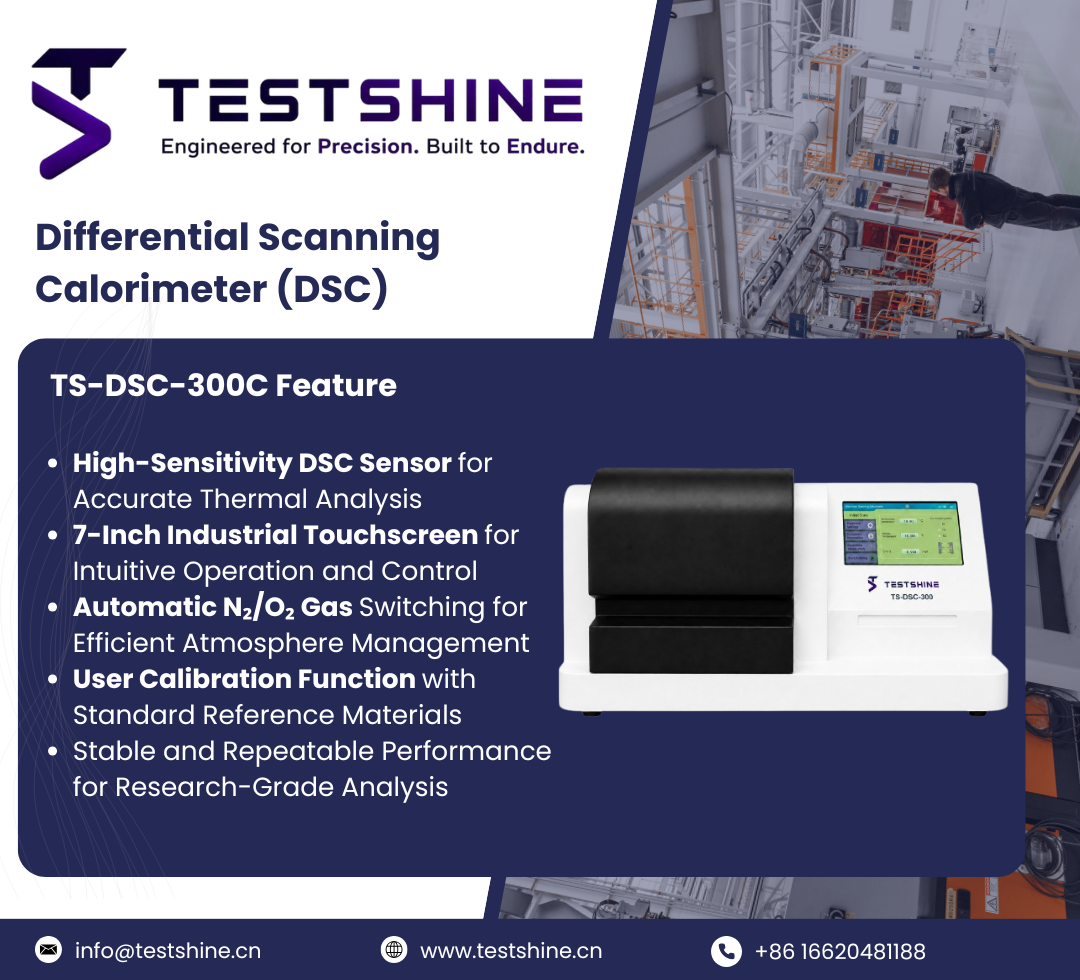
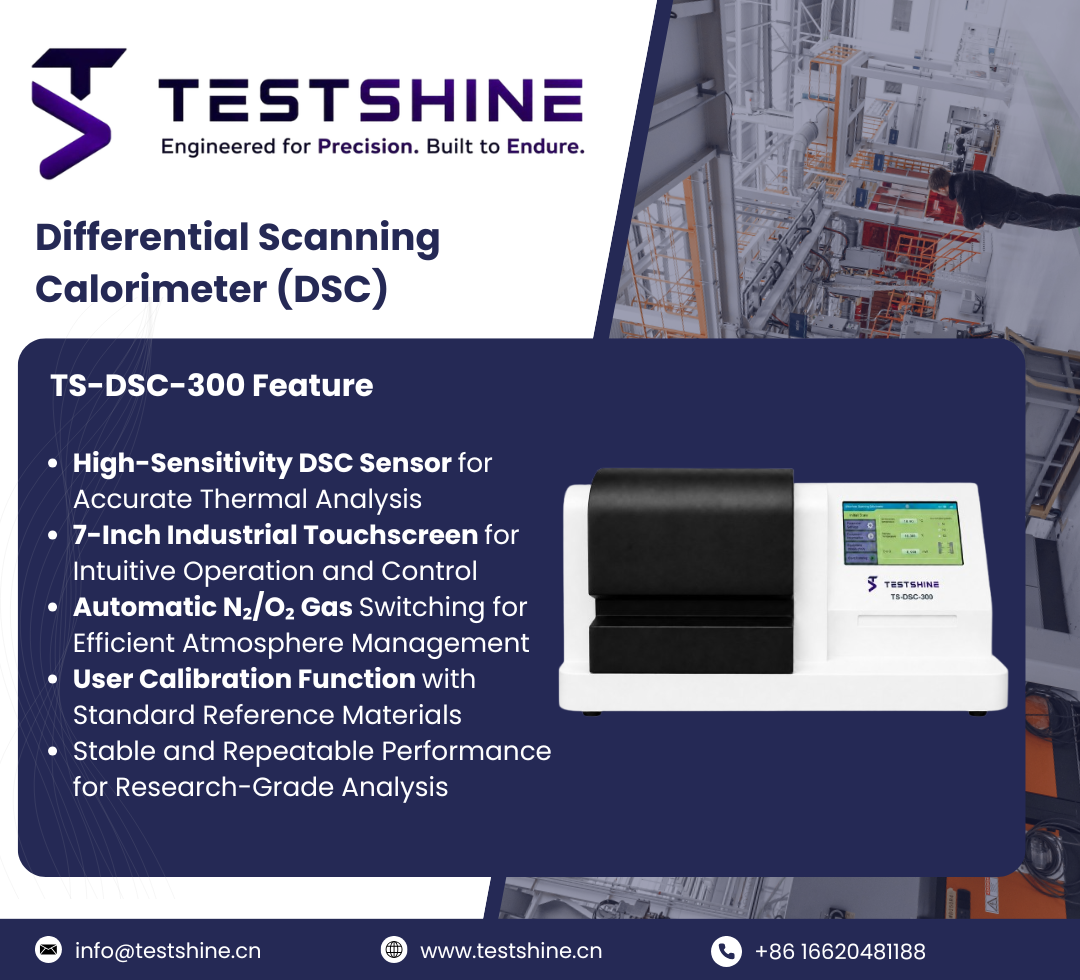
The TS-DSC-300 is a high-precision thermal analysis instrument designed to accurately measure heat flow associated with physical and chemical transitions in materials. Built for advanced research, product development, and quality assurance, it delivers reliable thermal characterization across polymers, plastics, pharmaceuticals, chemicals, composites, and adhesives.
Key Specifications
Wavenumber Range
7800–350 cm⁻¹
Resolution
0.85 cm⁻¹
Signal-to-Noise
>20,000:1
Communication
Ethernet & Wi-Fi
Global Shipping
50+ countries
2-Year Warranty
Parts & service
Expert Support
Dedicated team
Have a question about this instrument?
Talk to an expertProduct Introduction
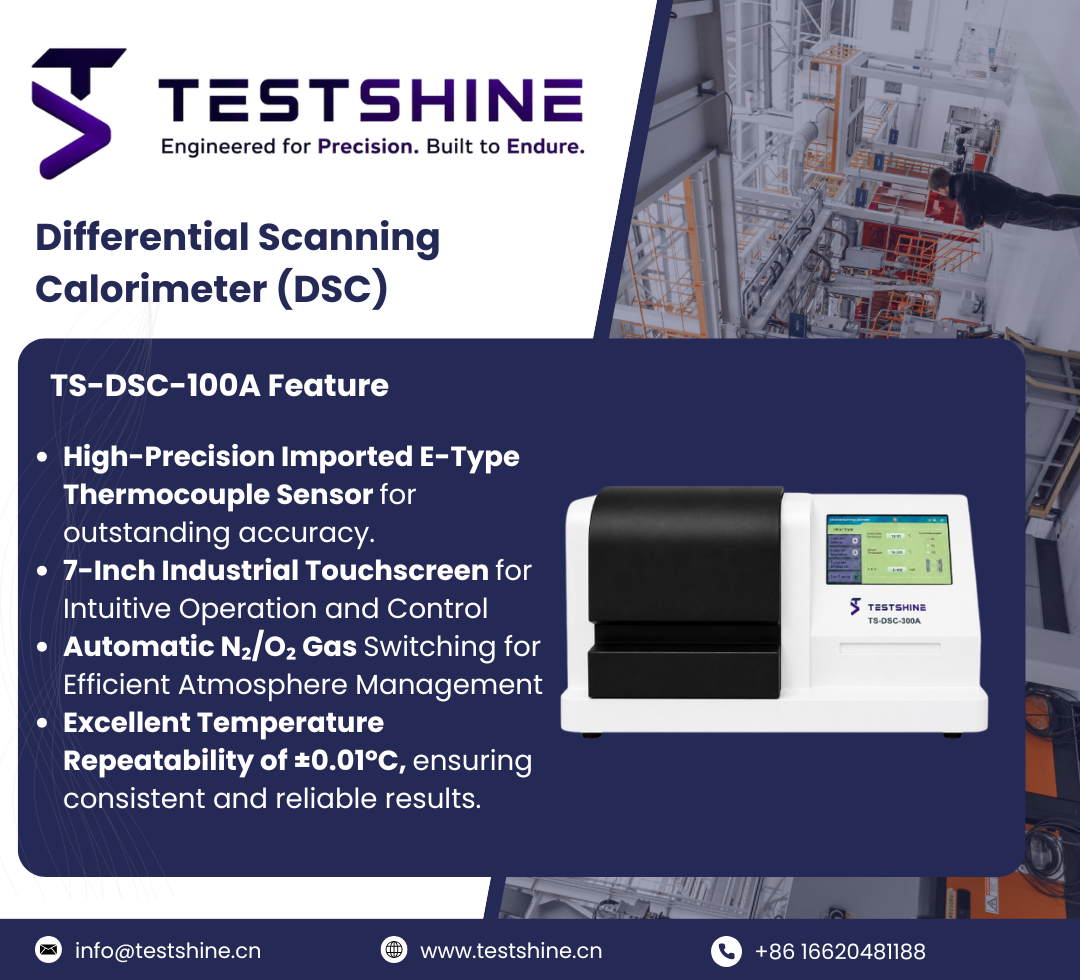
DSC-300 is one of the most accurate DSC series products launched by the company. The sensor is made of imported material E-pair, which has high accuracy, high sensitivity and good repeatability. The signal acquisition circuit has shielding protection, strong anti-interference, and extremely high baseline stability and repeatability.
DSC-300 differential scanning calorimeter can be used to test glass transition temperature, phase transition temperature, melting point, enthalpy value, curing temperature, product stability, oxidation induction period, etc. It is competent in the research of pipes, polymers, chemicals, food, medical treatment and many other fields, and its products serve universities, enterprises, third-party measurement and quality inspection units, with a wide range of applications to meet the testing needs of various industries.
Key Features
- Industrial 7-inch touch screen with rich information.
- New furnace structure, better baseline and higher precision. Heating by indirect conduction, high uniformity and stability, reduced pulse radiation, better than traditional heating mode.
- USB communication interface, with strong universality, reliable communication without interruption, and support for self recovery connection function.
- Automatic switching of two atmospheric flows, fast switching speed and short stabilization time. At the same time increase one way protective gas input.
- The software is simple and easy to operate.
- Ultra high sensitivity, accuracy, 0.001mW, 0.001℃
- Excellent technical indicators, superior performance, high cost performance, widely used.
Technical Parameters
| Temperature Range | Room temperature ~ 600℃ |
| Temperature Resolution | 0.001℃ |
| Temperature Fluctuation | ±0.001℃ |
| Temperature Repeatability | ±0.01℃ |
| Heating Rate | 0.1 ~ 100℃/min |
| Incubation Time | Program setting ≤ 24h |
| Temperature Control | Heating up, constant temperature, cooling down (Full automatic program control) |
| DSC Range | 0 ~ ±600mW |
| DSC Resolution | 0.01uW |
| DSC Sensitivity | 0.001mW |
| Working Power Supply | AC220V/50Hz or customized |
| Atmosphere Control Gas | Nitrogen, Oxygen (Program setting / automatic switching) |
| Gas Flow | 0 – 200 mL/min |
| Gas Pressure | ≤ 0.5 MPa |
| Display Mode | 24bit color, 7-inch LCD touch screen display |
| Data Interface | Standard USB interface |
| Parameter Standard | Equipped with reference materials (indium, tin); user can correct the temperature independently |
| Thermocouples | Multiple sets: one group measures sample temperature, one group measures furnace temperature, one group measures internal ambient temperature |
| Cooling Device | Air cooling device (Optional: semiconductor <-40 ~ 550℃>, liquid nitrogen refrigeration <-150 ~ 550℃>) |
Applications
Oxidation Induction Period Test of PE, PPR and Other Pipes
The oxidation induction time (OIT) was measured by DSC (differential scanning calorimeter). The sample is usually heated to the specified temperature and constant temperature under nitrogen atmosphere, and then switched to oxygen atmosphere. After a period of time, the material begins to oxidize and release heat. The released heat is detected by the sensor, and the induced oxidation time (OIT) is obtained through software analysis. The length of the oxidation induction time is a parameter of the oxidation decomposition resistance of the reaction material, which is still very meaningful. Usually, the parameter must be detected for buried plastic pipes.
Glass Transition Test of Resin and Other Materials
For amorphous polymers, when the polymer changes from a high elastic state to a glass state through cooling, or from a glass state to a high elastic state through heating, the process is called the glass transition, and the temperature at which the glass transition occurs is called the glass transition temperature. For crystalline polymers, the glass transition refers to the transition of the amorphous part from the high elastic state to the glass state (or the glass state to the high elastic state). Therefore, glass transition is a common phenomenon in polymers. However, the glass transition phenomenon is not limited to polymers, and some small molecular compounds also have glass transition.
Material Melting Point and Enthalpy Test (Thermal Stability Test)
The melting point is the temperature at which a solid changes its state of matter from solid to liquid, and the peaks of multi-component mixtures are also multi-peaks; The measurement of enthalpy value is also applicable to the measurement and analysis of crystallinity.
Curing Test of Glue and Other Materials
Refers to the process of material from low molecular weight to high molecular weight, and the strength of solidified sample will be higher.