
Haze Meter
Haze & Light Transmittance Measurement
 1 / 4
1 / 4Haze Meter
Key Specifications
Test Parameters
Haze & Transmittance
Test Range
0 – 100%
Light Source
Full Spectrum LED (400–700 nm)
Standards
ASTM D1003 / ISO 13468 / ISO 14782

Global Shipping
50+ countries
2-Year Warranty
Parts & service
Expert Support
Dedicated team
Have a question about this instrument?
Talk to an expertProduct Introduction
Haze and light transmittance are two of the most widely referenced optical quality indicators in the plastics, glass, film, coatings, and display industries. Haze refers to the percentage of transmitted light that is scattered away from the incident beam by more than 2.5 degrees, giving a material a cloudy or hazy appearance, while total luminous transmittance describes the overall proportion of incident light that passes through a sample. Together, these two values are used to characterize the clarity and optical performance of transparent and translucent materials.
A haze meter is the instrument used to measure these two properties quickly and repeatably. It is a standard piece of quality-control equipment in production lines and testing laboratories for industries such as optical films, packaging, automotive glazing, eyewear, mobile device covers and protective films, and flat-panel displays, where consistent optical clarity directly affects both product performance and perceived quality.
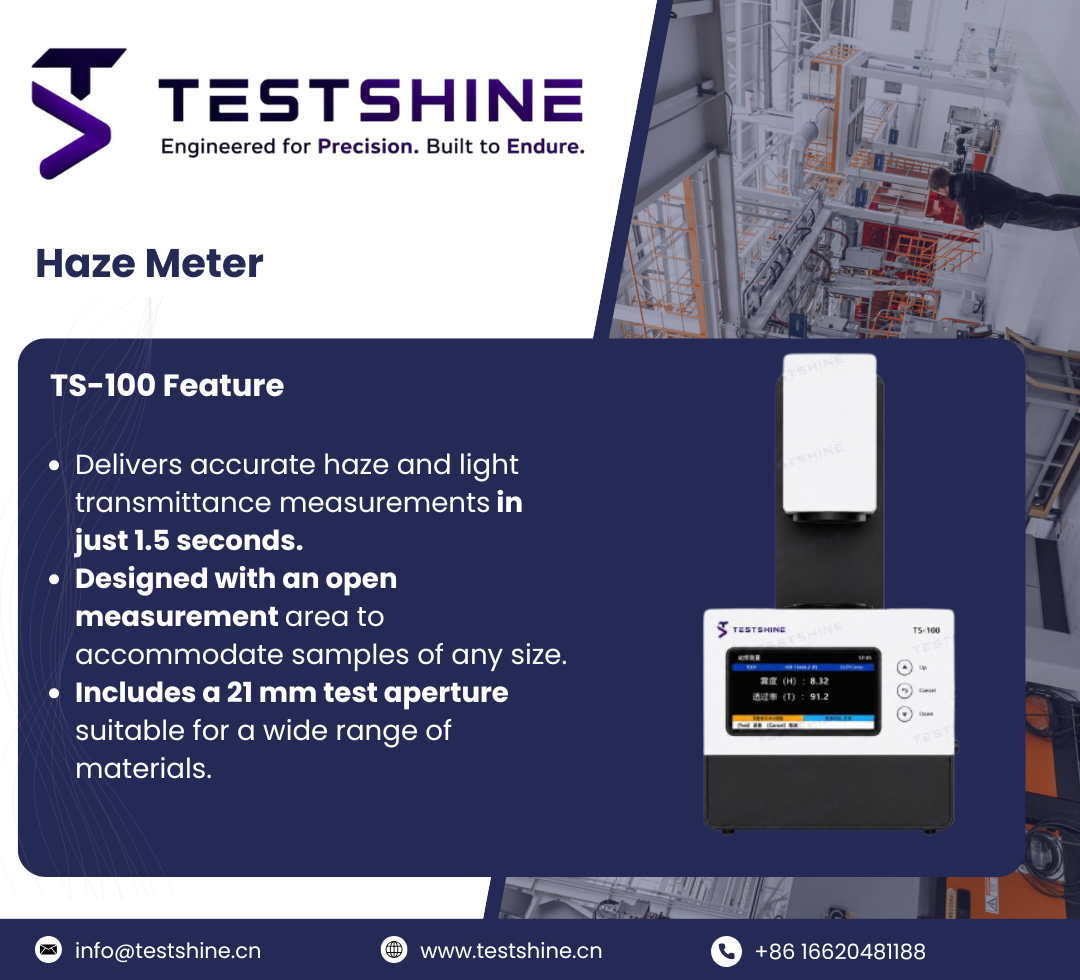
The TH-100 Professional Edition Haze Meter is designed to provide fast, accurate and standard-compliant haze and transmittance measurements for both quality assurance and research applications. The instrument's design, performance and specifications are summarized below.
Technical Parameters
The technical specifications below are provided exactly as documented for the TH-100 Professional Edition Haze Meter.
| Model | Haze Meter |
| Character | ASTM D1003/D1044 and ISO13468/ISO14782 standard for haze measurement and light transmittance measurement. Open measurement area and samples can be tested vertically and horizontally. Application: glass, plastic, film, display screen, packaging and other industries. |
| Illuminants | D65, A, C |
| Standards | ASTM D1003/D1044, ISO13468/ISO14782, GB/T 2410, JJF 1303-2011, CIE 15.2, GB/T 3978, ASTM E308, JIS K7105, JIS K7361, JIS K 7136 |
| Test Parameter | ASTM and ISO (HAZE), Transmittance (T) |
| Test Aperture | 21mm |
| Instrument Screen | 5 inches color LCD screen |
| Haze Repeatability | Φ21mm aperture, Standard Deviation: within 0.08 (when a haze standard with value 40 is measured 30 times at 5-second interval after calibration) |
| Transmittance Repeatability | ≤0.1 unit |
| Geometry | Transmittance 0/D (0 degree illumination, diffused receiving) |
| Integrating Sphere Size | Φ154mm |
| Light Source | 400~700nm full spectrum LED light source |
| Test Range | 0-100% |
| Haze Resolution | 0.01 unit |
| Transmittance Resolution | 0.01 unit |
| Sample Size | Open space, no size limit |
| Data Storage | 20,000 pcs of samples |
| Interface | USB |
| Power Supply | DC12V (110-240V) |
| Working Temperature | +10 – 40 °C (+50 – 104 °F) |
| Storage Temperature | 0 – 50 °C (+32 – 122 °F) |
| Size | L × W × H: 310mm × 215mm × 540mm |
Haze Meter Application
The TS-100 is used across a broad range of transparent and translucent materials where optical clarity is a key quality parameter. Representative application areas include:
Mobile Device Cover
Tempered glass and cover lenses for smartphones and tablets must maintain high transmittance and low haze so that the display beneath remains bright, sharp and free of visible cloudiness. Haze testing during manufacturing helps ensure cover glass batches meet the clarity level expected by device brands.
Phone Film
Screen protection films are applied directly over the display, so any haze in the film is immediately visible to the end user as blurriness or a milky appearance. Manufacturers use haze and transmittance testing to grade film quality and to distinguish standard films from premium, high-clarity variants.
Plastic Film
Plastic films used in packaging, agriculture, optical products and industrial applications are tested for haze and transmittance to confirm they meet the optical clarity or light-diffusion properties specified by the customer, and to detect processing defects such as uneven stretching, contamination or surface scratching.
Glasses
Eyewear lenses, including prescription lenses, sunglasses and safety glasses, are tested for haze to confirm that the lens does not distort or scatter light in a way that would impair the wearer's vision, and to verify compliance with relevant optical quality standards.
In each of these applications, haze and transmittance measurements help manufacturers verify that materials meet optical clarity requirements, monitor consistency between production batches, and confirm compliance with the relevant ASTM/ISO/JIS/GB standards referenced in the Technical Data table above.