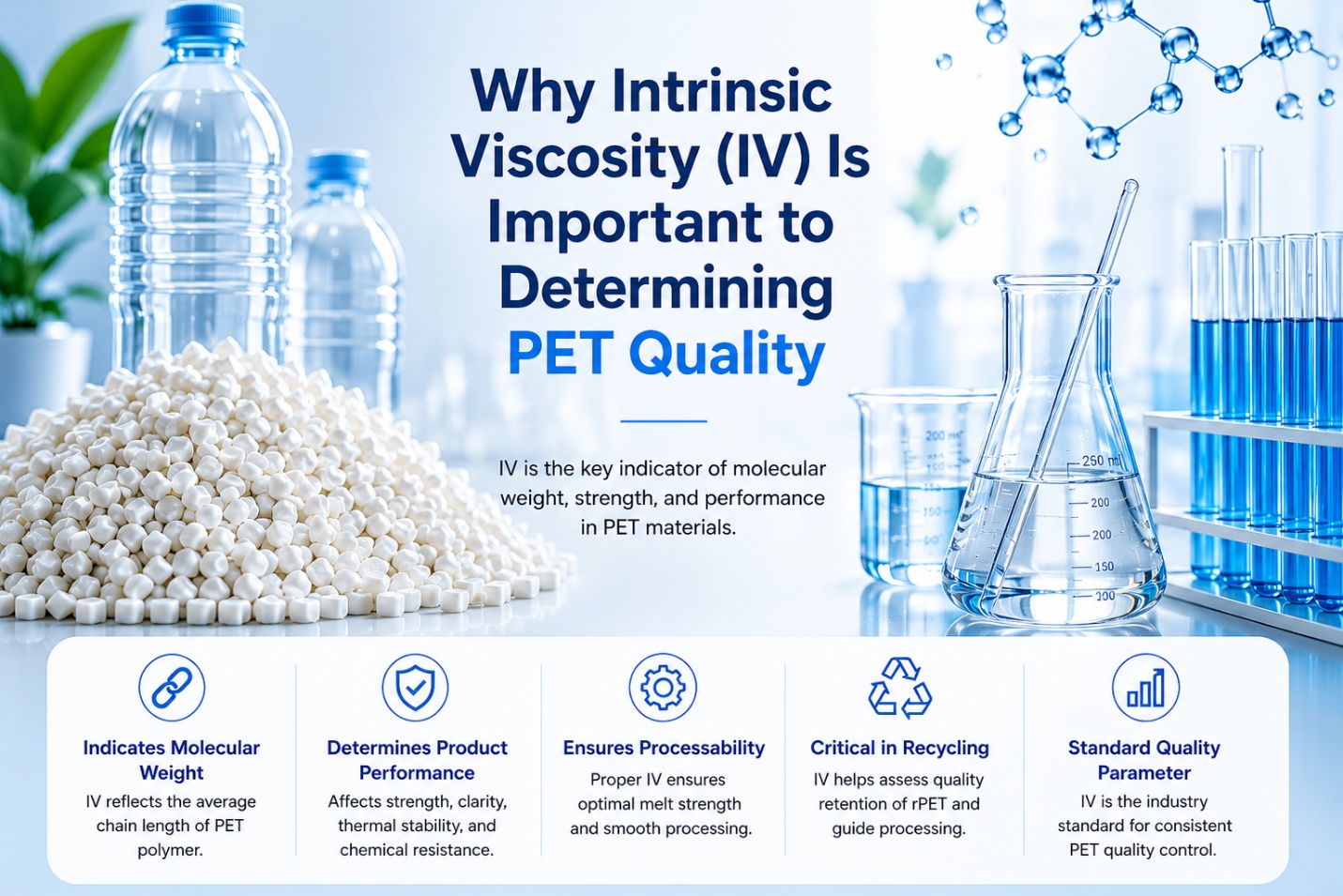
Why Intrinsic Viscosity (IV) Is Important to Determining PET Quality
Executive Summary
Polyethylene terephthalate (PET) is one of the most widely used thermoplastic polyesters in the world today, found in beverage bottles, food packaging film, textile fibers, and a variety of engineering components. Across all of these uses, a single laboratory measurement stands out as the clearest marker of resin quality: intrinsic viscosity, commonly shortened to IV.
IV is more than a figure on a data sheet. It reflects the average molecular weight and chain length of the polymer, and those characteristics in turn determine how strong, heat tolerant, and processable the finished product will be. This article looks at what intrinsic viscosity actually represents, why the PET industry relies on it rather than the melt flow index used for other plastics, how it is built up during polymerization, how it influences the properties of finished PET goods, and how producers measure, maintain, and safeguard it throughout drying, processing, and recycling. It finishes with a look at how quality programs are generally structured around IV and where the technology is heading as recycled content requirements continue to climb.
1. Background: PET as a Packaging Material
PET is a member of the polyester family of thermoplastics and is manufactured commercially by reacting purified terephthalic acid (or dimethyl terephthalate) with mono ethylene glycol. The reaction proceeds in stages: an initial esterification or transesterification step forms short oligomer chains, followed by a polycondensation stage, carried out under vacuum at elevated temperature, that links these oligomers into much longer polymer chains while releasing water or methanol as byproducts. The extent to which these chains grow during polycondensation is what ultimately determines the resin's intrinsic viscosity.
PET's popularity as a packaging material stems from an unusual combination of traits: it is lightweight, transparent, resistant to a broad range of chemicals, capable of withstanding internal pressure (which makes it well suited to carbonated beverages), and recyclable through both mechanical and chemical means. None of these advantages materialize, however, unless the resin's molecular weight, and by extension its IV, sits within the correct range for its intended application. A resin that is chemically identical to a high performing grade but carries a lower IV will fall short mechanically, and it cannot be substituted in without redesigning the product around it. This sensitivity to molecular weight explains why IV occupies such a central place as a quality measure across the entire PET supply chain, from resin producers through converters to brand owners.
2. What Is Intrinsic Viscosity?
Intrinsic viscosity measures the contribution a single polymer molecule makes to the viscosity of a dilute solution, extrapolated to the point of infinite dilution. Put simply, it captures how much a polymer thickens a solvent once dissolved in it, once concentration effects and interactions between chains have been accounted for. Because the measurement isolates individual polymer chains, it offers a dependable picture of a resin's average molecular weight and chain length.
In routine testing, IV is measured with a capillary viscometer, typically of the Ubbelohde or Cannon-Fenske type, by timing how long a dilute PET solution (commonly dissolved in phenol combined with 1,2 dichlorobenzene or a similar blend) takes to pass through the instrument at a tightly controlled temperature, and then extrapolating that reading to zero concentration.
3. How Intrinsic Viscosity Is Built During Polymerization
IV is not a fixed property built into PET's chemistry; it is a manufacturing outcome, shaped deliberately during polymerization and, for higher IV grades, extended further afterward. Production starts with a melt phase reaction between purified terephthalic acid and mono ethylene glycol, using a catalyst (commonly based on antimony, titanium, or germanium) at temperatures generally between 270°C and 290°C. As the reaction proceeds under progressively deeper vacuum, byproduct water or glycol is continuously removed, driving the reaction toward increasingly longer polymer chains.
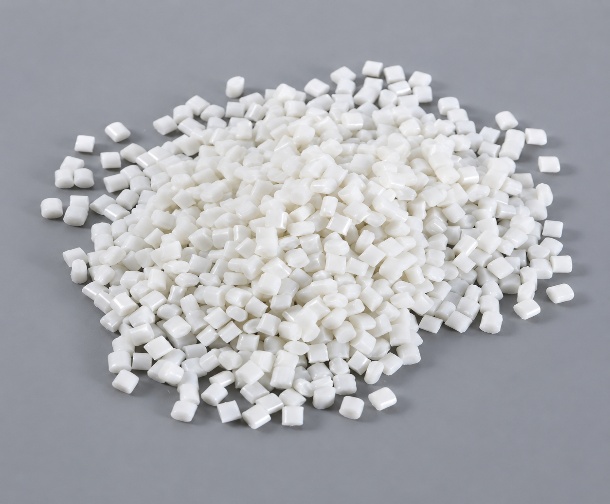
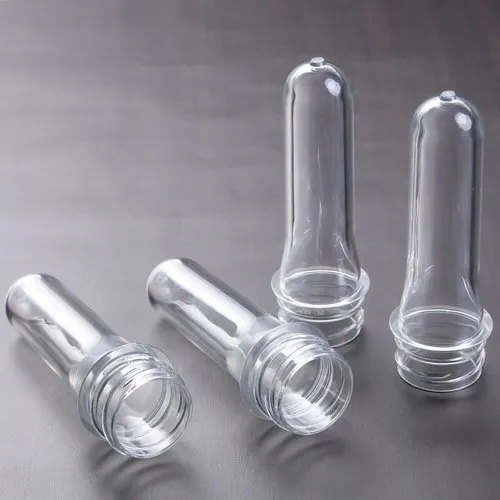
Left on its own, melt phase polymerization typically yields resin with an IV around 0.60 to 0.65 dL/g. That level suits fiber and some film applications but is too low for bottle grade or engineering grade resin. To reach the higher IV values required for water and carbonated beverage bottles, the melt phase chip goes through Solid State Polycondensation (SSP), the same process described later in this article for recycled PET, but applied here to virgin chip. During SSP, the semi crystalline chip is heated below its melting point (typically 200°C to 220°C) under vacuum or a flow of dry inert gas for many hours. Because the chip remains solid rather than molten, the chains continue to grow through solid state diffusion of end groups, avoiding the degradation risk associated with prolonged melt phase processing. This two stage approach, melt phase polymerization followed by SSP, is the standard industrial route resin producers use to reliably reach the 0.76 to 1.10 dL/g range needed for bottle grade and engineering grade PET.
Catalyst selection, temperature profile, vacuum level, and residence time at each stage are process variables that resin producers control closely, since each one influences the final IV along with related qualities such as color and acetaldehyde content. Because of this sensitivity, producers usually keep their internal process limits tighter than the customer's final specification, building in a buffer against the small, unavoidable IV losses that occur later during drying, injection molding, and stretch blow molding.
4. Why PET Relies on IV Rather Than Melt Flow Index (MFI)
Melt Flow Index (MFI) is the standard rheological check for commodity polyolefins such as polyethylene and polypropylene. PET, however, is characterized almost universally through IV instead, and there are solid technical reasons behind that choice:
- PET is highly sensitive to moisture, even small amounts of residual water trigger hydrolytic breakdown once the material reaches melt processing temperatures.
- In a standard melt flow test, PET degrades thermally and hydrolytically while molten, changing its molecular weight during the very test intended to characterize it, which makes the result unreliable.
- An IV test is run in dilute solution at low temperature, so it avoids the thermal history and degradation effects that would otherwise distort the measurement.
- Because it is unaffected by melt degradation, IV gives a far more accurate and repeatable picture of the resin's true molecular weight as supplied.
This is why IV has become the accepted global benchmark for PET quality, from raw resin chips to preforms, bottles, films, and recycled flake. MFI is not simply unsuited to PET by convention, the underlying chemistry actively works against it. PET's ester bonds are prone to both thermal breakdown and hydrolysis at melt temperatures, so any test that keeps the resin molten for an extended period ends up reflecting the test conditions as much as the resin itself. IV testing avoids this problem entirely by characterizing the polymer while it is dissolved at low temperature, well before conditions that could cause degradation are reached.
5. The Relationship Between IV and Molecular Weight
Intrinsic viscosity is connected to a polymer's average molecular weight through a well established relationship from polymer science known as the Mark-Houwink relationship. In practical terms, a higher IV signals a higher average molecular weight and longer polymer chains, which translates into better mechanical, thermal, and barrier performance in the finished product. This is why IV specifications appear in nearly every PET resin and preform purchasing agreement, it is essentially a molecular weight specification expressed in a form that can be measured quickly and reliably in a quality control lab.
It is worth remembering that IV is an average value, not an absolute one. Any real PET resin contains a distribution of chain lengths rather than chains of a single uniform size, and the IV reported on a certificate of analysis reflects a viscosity average across that distribution. Two batches with the same IV can, in principle, have somewhat different molecular weight distributions and behave slightly differently during processing, even though their bulk IV values look identical. For this reason, IV is normally used alongside other checks, such as acetaldehyde content, moisture level, and color (measured by L*, a*, b* values), rather than relied on by itself.
Worked Example: Relating IV to Molecular Weight
Consider two PET batches tested under the same solvent and temperature conditions. Batch A returns an IV of 0.72 dL/g, and Batch B returns an IV of 0.82 dL/g. Because intrinsic viscosity scales with molecular weight, Batch B's higher IV points directly to a proportionally higher viscosity average molecular weight than Batch A, even without working out an absolute figure. In practice, resin producers and converters rarely calculate absolute molecular weight at all; they work directly in IV units, since IV can be measured quickly and precisely, while determining absolute molecular weight calls for more specialized techniques such as gel permeation chromatography (GPC). The example still illustrates the core idea behind every IV specification in the industry: a target IV is, in effect, a target molecular weight expressed in a more convenient and repeatable measurement unit.
6. Impact of Intrinsic Viscosity on PET Product Properties
Because IV stands in for molecular weight and chain length, it shapes nearly every performance category of a finished PET product. The five areas below summarize the main effects.
6.1 Mechanical Properties
- Higher tensile strength
- Better impact and burst strength
- Improved creep and fatigue resistance
- Higher top load performance (important for bottle stacking and transport)
6.2 Processing Performance
- Better melt strength during extrusion and stretch blow molding
- More stable injection molding of preforms
- Smoother, more controllable blow molding
- More even wall thickness and fewer processing defects
6.3 Barrier Properties
- Lower oxygen transmission rate (OTR), extending shelf life for oxygen sensitive contents
- Lower carbon dioxide permeability, important for carbonated beverages
- Lower water vapor transmission rate (WVTR)
- Longer overall shelf life for packaged products
6.4 Thermal Stability
- Greater resistance to thermal breakdown during processing
- Less acetaldehyde (AA) generated, an unwanted byproduct that can affect taste and odor in food and beverage packaging
- Better performance in hot fill applications, where containers must handle high filling temperatures
6.5 Product Quality
- Better optical clarity
- Improved dimensional stability
- Better environmental stress crack resistance (ESCR)
- Longer service life for the finished product
7. Typical IV Values Across PET Grades
Different end uses place different demands on molecular weight and chain length, so PET resin is produced across a range of IV grades. The table below shows representative IV ranges and their typical applications.
| PET Grade | IV Range (dL/g) | Typical Application |
|---|---|---|
| Polyester Fibre Grade | 0.58 to 0.65 | Textile fibres |
| Film Grade | 0.60 to 0.72 | Packaging films |
| Sheet Grade | 0.72 to 0.78 | Thermoforming sheets |
| Water Bottle Grade | 0.76 to 0.82 | Mineral water bottles |
| CSD Bottle Grade | 0.80 to 0.86 | Carbonated soft drink bottles |
| Engineering Grade | 0.90 to 1.10 | Engineering components |
As the table shows, applications with tougher mechanical or barrier requirements, such as carbonated soft drink (CSD) bottles that must hold internal pressure, or engineering components that need high structural strength, call for higher IV resin grades.
This variation is not arbitrary; it reflects the very different demands of each end use. Fibre grade resin, spun through fine spinnerets for textile yarns, favors low melt viscosity and quick crystallization over sheer chain length, so a comparatively low IV is both sufficient and preferred for easier processing. Film grade resin sits a bit higher, since biaxially oriented film needs enough chain entanglement to stretch evenly in both directions without tearing, while still flowing well enough to be cast at high line speeds. Bottle grade resin sits near the top of the range because bottles must withstand top load compression during storage and transport, internal pressure from carbonation, and drop impact, all while remaining thin walled and lightweight, demands that only sufficiently long polymer chains can meet. Engineering grade PET, often reinforced with glass fibre for automotive and electrical components, needs the highest IV of all, since it must hold its shape and strength under continuous mechanical and thermal load over its service life.
8. The Effect of Moisture on Intrinsic Viscosity
PET is hygroscopic, meaning it readily absorbs moisture from the surrounding air. This matters a great deal in practice, because moisture directly and permanently lowers IV through hydrolytic chain scission, a reaction in which water molecules attack and break the ester bonds along the polymer backbone.
When PET carrying moisture above roughly 30 to 50 parts per million (ppm) is heated to melt processing temperatures, the chains are shortened, lowering both molecular weight and IV. The damage is cumulative and cannot be reversed by further heating; once a chain is broken by hydrolysis, no amount of additional processing restores it. That is why PET resin must be thoroughly dried before melt processing. Standard practice is drying at 160°C to 180°C for four to six hours, aiming for residual moisture below 30 to 50 ppm before extrusion, injection, or blow molding.
In production, this drying step normally takes place in desiccant dryers that circulate dew point controlled hot air through a bed of resin pellets, continuously pulling moisture out before the material reaches the injection or extrusion unit. Dryer performance is monitored closely as part of routine quality control, since an under performing dryer is one of the most common causes of unexpected IV loss on the shop floor. Plants running high volume preform lines typically check hopper dew point, residence time, and air temperature on a fixed schedule, because even a small slip in any of these parameters can show up as a measurable drop in finished preform IV.
9. IV Reduction During Processing
Even with properly dried resin, some IV loss during processing is normal and expected. How much depends on the process type, temperature profile, and how long the material sits in the melt:
- Injection molding of preforms: typically loses about 0.01 to 0.03 dL/g
- Stretch blow molding: typically loses about 0.005 to 0.02 dL/g
- Losses tend to be larger with higher moisture content, higher processing temperatures, longer residence times, and repeated processing or reprocessing cycles
Because these losses stack up across the supply chain, from resin drying, to preform injection, to reheat and stretch blow molding, process engineers need to start with a high enough resin IV to make sure the finished container still meets its target IV after all processing steps.
10. Common Causes of Off Specification IV: A Troubleshooting Guide
When a batch of preforms or bottles comes back with an IV result outside its target range, the cause can almost always be traced to one of a handful of recurring process issues. The table below lists the most common causes seen on the shop floor, along with the usual corrective actions.
| Symptom | Likely Root Cause | Typical Corrective Action |
|---|---|---|
| IV lower than resin certificate value | Inadequate drying / high residual moisture | Verify dryer dew point and temperature; extend drying time |
| IV drifts down over a long production run | Excessive barrel residence time or hot spots | Check screw speed, back pressure, and heater zone calibration |
| IV lower with increased regrind usage | High proportion of reprocessed / degraded material | Reduce regrind ratio; verify regrind's own IV before blending |
| IV inconsistent between cavities of one mold | Uneven melt temperature distribution | Balance hot runner temperatures; inspect for worn check rings |
| IV acceptable at resin stage but low in bottles | Excess reheat stretch blow oven temperature | Reduce preform reheat temperature; verify IR lamp calibration |
Using a troubleshooting matrix like this lets quality and process engineering teams move quickly from an out of specification result to a corrective action, cutting down on scrap and reducing how long a line spends producing off quality product before the issue is resolved.
11. Intrinsic Viscosity and Recycled PET (rPET)
As recycled PET (rPET) becomes more common in packaging, managing IV has taken on particular importance, since recycled material naturally arrives with a lower and more variable IV than virgin resin. Each recycling cycle adds more heat history and potential moisture exposure, which reduces IV further. The practical effects are well understood in the industry:
- Each successive recycling cycle tends to reduce IV further
- Lower IV in recycled feedstock means weaker melt strength, more brittleness, and lower overall product quality
- Solid State Polycondensation (SSP) is widely used afterward to rebuild molecular weight, and therefore IV, in recycled PET flake, restoring it to a level suitable for food contact and other demanding applications
SSP works by heating PET chips or flake below their melting point under vacuum or inert gas flow for an extended period, letting residual reactive end groups continue polycondensation reactions in the solid state. This raises average molecular weight and IV without the degradation risk of melt phase reprocessing, making it essential for producing food grade rPET from otherwise lower IV recycled material.
Beyond SSP, many converters manage IV variability by blending rPET flake with virgin resin in carefully calculated ratios, letting the higher IV of the virgin fraction offset the lower IV of the recycled fraction and bring the blend back within specification. As recycled content targets from regulators and brand owners continue to rise, IV control has become one of the central engineering challenges in the rPET supply chain. Every additional percentage point of recycled content in a bottle or preform recipe makes it more important to closely monitor and correct IV before the material reaches the molding stage.
12. Intrinsic Viscosity vs. Melt Flow Index: A Comparative Summary
| Intrinsic Viscosity (IV) | Melt Flow Index (MFI) |
|---|---|
| Used primarily for PET | Used primarily for PE, PP, PS, and similar polyolefins |
| Indicates average molecular weight directly | Indicates melt flow rate under standard load and temperature |
| Higher IV corresponds to higher molecular weight and strength | Higher MFI corresponds to lower melt viscosity |
| Measured in dL/g | Measured in g/10 min |
| Solution based test (unaffected by thermal history) | Melt based test (subject to thermal/degradation effects during test) |
13. Specification and Contractual Practices Around IV
Because IV is so closely tied to end use performance, it is rarely left as a loose descriptive term in commercial agreements between resin producers, converters, and brand owners. Purchase specifications typically set a target IV together with an allowable tolerance, commonly around ±0.02 to ±0.04 dL/g around the nominal value, along with the specific test method (ASTM D4603 or ISO 1628-5) and solvent system used for verification. This precision matters because IV values from different solvent systems or test temperatures are not directly interchangeable; a resin certified under one solvent system cannot simply be compared numerically against a specification written for another without an appropriate conversion or retest.
Certificates of analysis accompanying each shipment of resin or preforms generally report IV alongside other release criteria such as moisture content, acetaldehyde level, color values, and melting point, letting the receiving quality department confirm conformance before the material is released to production. Where a shipment tests outside the agreed tolerance, quality agreements typically spell out the resolution process, which may include a price adjustment, rework such as additional SSP treatment, or outright rejection of the batch. Given how much commercial weight rests on this single figure, both resin producers and converters generally invest in carefully calibrated and cross checked viscometry labs, and periodically take part in round robin testing programs with other labs to confirm their reported IV values stay consistent with the wider industry.
14. Test Methods and Standards
IV testing follows internationally recognized standards to keep results consistent and comparable across laboratories and suppliers:
- ASTM D4603: Standard Test Method for Determining Inherent Viscosity of Poly(Ethylene Terephthalate)
- ISO 1628 (Part 5): Determination of the viscosity of polymers in dilute solution, specifically for polyester (PET) resins
- Both standards call for measuring viscosity with an Ubbelohde or Cannon-Fenske capillary viscometer, with the polymer dissolved in a specified solvent system and the flow time measured at a precisely controlled temperature (commonly 25°C to 30°C, depending on the solvent system used)
15. Step by Step: How an IV Test Is Performed in the Laboratory
While the underlying calculation of intrinsic viscosity technically involves extrapolating to infinite dilution, most quality control labs use a simplified single point method that has been correlated against the full multi concentration approach, since it is faster while still accurate enough for routine release testing. A typical single point IV test goes through these stages:
- A precisely weighed sample of dried PET resin, preform regrind, or bottle flake is dissolved in a specified solvent system, often a phenol and 1,2 dichlorobenzene mixture or equivalent, at a controlled temperature until fully dissolved.
- The solution is filtered if necessary and brought to the test temperature, typically held steady using a thermostatted water bath.
- The solution is loaded into a capillary viscometer, and the time it takes to flow between two calibrated marks is measured.
- The flow time of the pure solvent alone is measured separately under the same conditions.
- Relative viscosity is calculated as the ratio of solution flow time to solvent flow time, and specific viscosity is derived from that ratio.
- Using a recognized correlation method commonly cited in ASTM D4603 and ISO 1628, the specific viscosity at that single concentration is converted into an estimated intrinsic viscosity.

Because this process depends on precise temperature control, accurate weighing, and a properly calibrated viscometer, labs running IV tests under a certified quality system typically check their equipment against certified reference standards on a set schedule, and often run duplicate samples to confirm repeatability before releasing a result on a certificate of analysis.
16. Quality Control Practices Built Around IV
Because IV touches nearly every downstream property of a PET product, it is typically monitored at multiple checkpoints across the manufacturing chain rather than at a single point. A representative quality control program includes checking incoming virgin resin's IV against the supplier's certificate of analysis, sampling preforms directly off the injection molding line, and periodically testing finished bottles or containers after stretch blow molding. Comparing IV at each of these checkpoints lets a converter pinpoint exactly where any unexpected viscosity loss is occurring, whether in resin drying, barrel residence time, or excessive regrind use, and correct it before it affects a large volume of product.
Statistical process control (SPC) charting of IV results is common practice in larger converting operations, with control limits set around the target IV for each product line. A batch or shift that trends outside these limits typically triggers an investigation into drying conditions, machine temperature settings, or raw material variability before production continues. Because the capillary viscometry test itself takes time to complete, some facilities supplement lab IV testing with faster, correlated in line indicators, such as melt pressure trends or torque monitoring on the extruder, to catch major deviations in near real time, while still relying on the formal IV test for definitive quality sign off.